
The Selective Memory Behind Britain’s Anti-Israel Property Campaign
How to Shape a Narrative

For a couple of weeks this month, a one day property exhibition in North London achieved what few property exhibitions ever manage: it became a matter of apparent national importance.
The Great Israeli Real Estate Event attracted protests, parliamentary interventions, media coverage and political outrage on a scale usually reserved for wars, financial crises or government scandals. Nearly 100 MPs and peers wrote to Home Secretary Yvette Cooper demanding action. Activist organisations mobilised against it. Demonstrators descended on Edgware. Social media warned darkly of Britain’s complicity in colonial expansion.
One might have thought a foreign army was preparing to land in Hertfordshire. Instead, it was a property fair. Not just any property fair, of course. This one involved Israel. And in modern Britain, that changes everything.
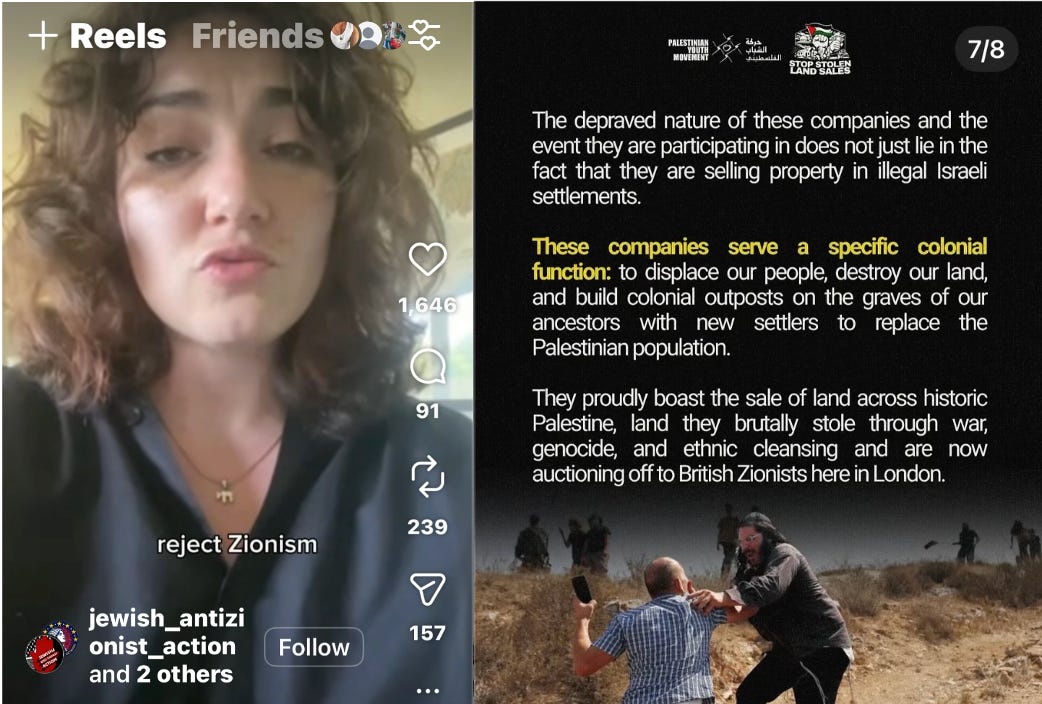
The campaign against the event rested upon claims that properties in Israeli settlements, including Gush Etzion in the West Bank, were being marketed in London. Critics described the properties as “stolen land”. Parliamentarians spoke of colonial expansion. Activists warned of Britain’s participation in dispossession.
Yet amid all the outrage, one awkward question remained surprisingly difficult to answer. What exactly was supposed to be illegal?
The UK government warns businesses of the legal and reputational risks associated with economic activity in Israeli settlements. The International Court of Justice has delivered an advisory opinion highly critical of Israel’s presence in the territories. Reasonable people can disagree about the legal status of settlements under international law.

What is much harder to establish is the proposition that discussing, advertising or facilitating the sale of such property in Britain is automatically a criminal offence. The distinction matters because much of the public debate appeared to assume the conclusion before examining the facts. More revealing than the legal arguments, however, was the language employed by the campaign itself.
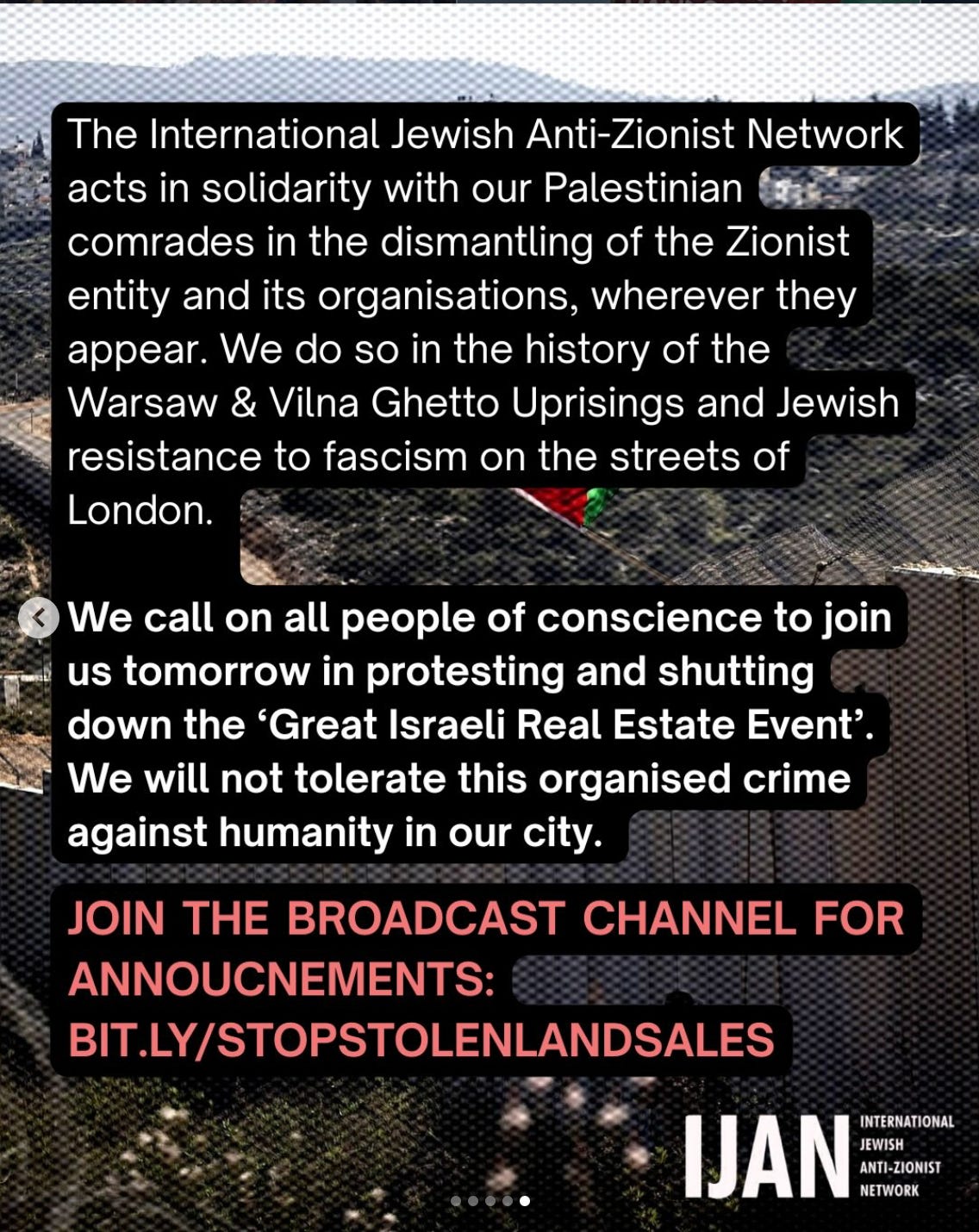
The International Jewish Anti-Zionist Network described the event as involving the sale of “stolen land” and “colonial land-sales” taking place within the “Imperial core”. Meanwhile, MPs and peers wrote to Yvette Cooper describing the event as part of “Israel’s project of colonial expansion”, facilitating the sale of land “stolen from Palestinians” and contributing to Palestinian dispossession “for over a century”.
Notice what is happening here.
This is not merely an objection to a particular property development. Nor is it simply a dispute over the precise legal status of settlements under international law.
Rather, the conflict is being framed through the language of colonialism, imperialism, oppression and resistance. Israel is cast as the coloniser. Palestinians are cast as the colonised. Once those roles have been assigned, the rest of the story largely writes itself.
The difficulty is that history is rarely so accommodating.
Take Gush Etzion. To many campaigners, this is simply another illegal settlement. End of discussion. Yet Gush Etzion is one of the most historically complicated places they could have chosen. Indeed, it stubbornly refuses to behave like a textbook example of European colonialism.
Jewish communities existed there before Israel’s independence. Land was acquired through purchase during the Mandate period. In May 1948, during the Arab-Israeli war, those communities were overrun. Jewish residents were killed, captured or forced to flee. The communities ceased to exist under Jordanian rule. It reads like a Nakba in reverse, the complexity of which might be too much for a progressive to compute.
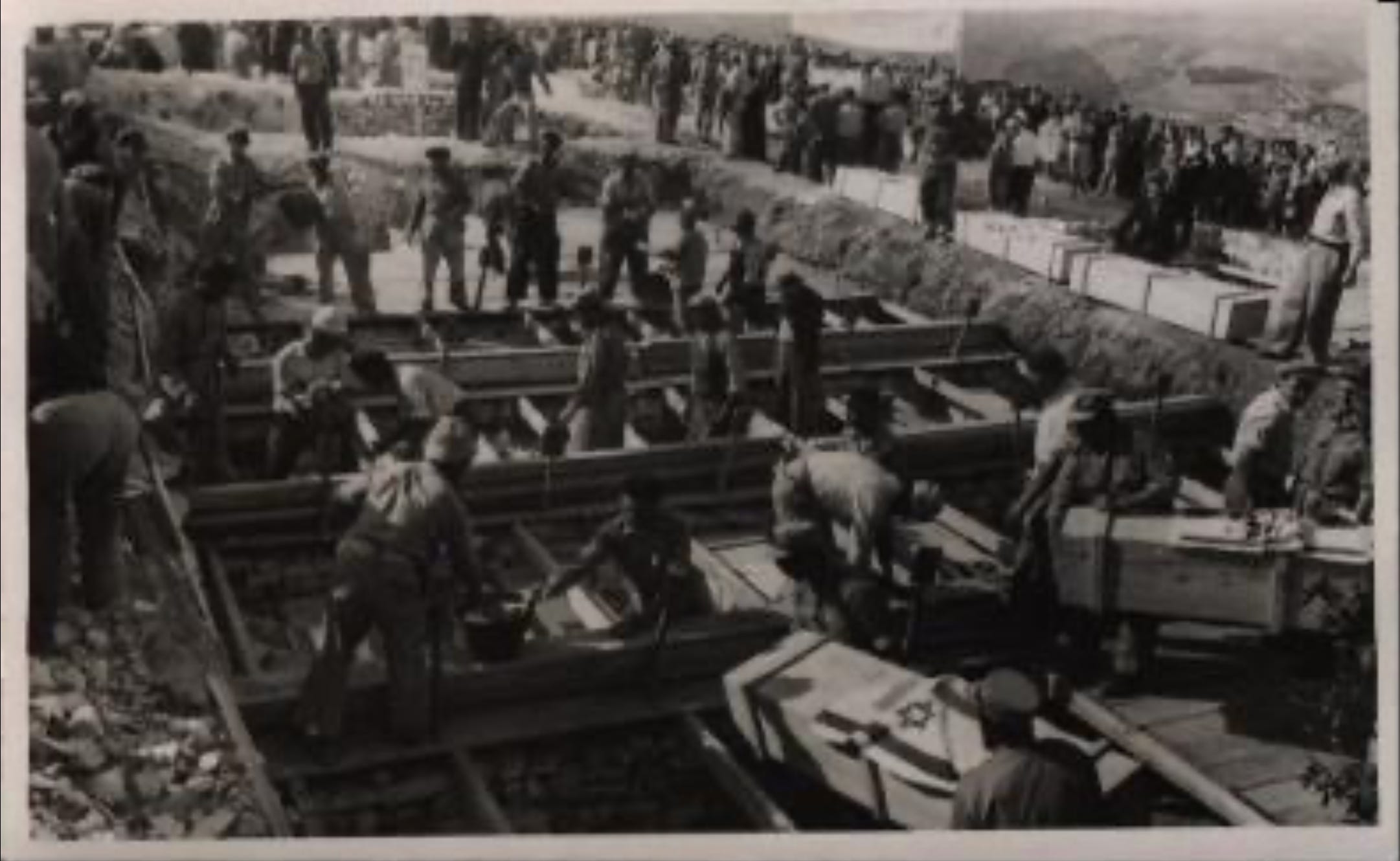
Following Israel’s victory in 1967, descendants of those communities returned. One does not have to support contemporary settlement policy to recognise that this history exists. Yet reading much of the campaign material, one could be forgiven for believing that history began in 1967.
The MPs’ letter speaks movingly of Palestinian refugees and their descendants. It condemns dispossession. It condemns displacement. It condemns stolen land. All perfectly legitimate subjects for discussion. What it does not mention is that Gush Etzion itself was a place from which Jews were displaced, the land itself stolen by Jordanian expansionist occupation.
Nor does it mention the approximately 850,000 Jews who left, fled or were expelled from Arab countries and Iran during the twentieth century, often leaving behind homes, businesses and property worth billions in today’s terms. Apparently, some refugees are remembered for generations. Others are quietly erased from the story.
This omission matters because it reveals something deeper than a disagreement about real estate. It reveals a tendency to view the conflict through a moral framework in which only one side possesses meaningful historical grievances. Palestinian displacement is central to the story. Jewish displacement is peripheral. Palestinian claims are enduring. Jewish claims are irrelevant. Palestinian suffering is evidence. Jewish suffering is context.
The result is not history. It is narrative construction.
And it helps explain why so many activists appear comfortable describing property in Gush Etzion as self-evidently “stolen”. After all, if one begins from the assumption that Jewish sovereignty is inherently illegitimate, then every Jewish community beyond the Green Line becomes evidence of colonialism regardless of its history.
This brings us to another uncomfortable question: Why does this issue generate such extraordinary attention in Britain at all?
The world contains numerous disputed territories. Northern Cyprus remains subject to unresolved property claims. There are territorial disputes stretching from the Caucasus to the Western Sahara. There are communities displaced by conflict across multiple continents.
Yet none of these provoke anything like the mobilisation witnessed over an Israeli property exhibition in North London. No parliamentary letters signed by scores of MPs. No major protest campaigns. No emergency political interventions.
Perhaps there are good reasons for this disparity. But it is surely reasonable to ask whether Israel is being judged according to standards not routinely applied elsewhere. The events outside the exhibition itself made this question even harder to ignore.

The controversy was presented as a protest against property sales in disputed territory. Yet many of the slogans heard outside the venue were not directed at settlements, real-estate transactions or even the boundaries of the West Bank. They were directed at the legitimacy of Israel itself.
Among the chants heard at the demonstration were “Smash the Zionist settler state” and “There is only one state, Palestine ‘48’”. The latter slogan is particularly revealing. It does not call for a Palestinian state alongside Israel. It refers to the entirety of the territory within Israel’s pre-1967 borders. The implication is difficult to avoid. This is not opposition to a particular policy. It is opposition to the continued existence of Israel as a Jewish state.
Reality remains stubbornly unimpressed by anti-Zionist wishful thinking. For nearly eighty years, movements have predicted, demanded or promised Israel’s disappearance. Israel’s response has been deeply inconsiderate. It keeps surviving. Indeed, after every major conflict it tends to emerge stronger than before. The vision of a future “Palestine ‘48’” may be emotionally satisfying to activists, but as a political programme it is roughly as plausible as a fantastical puff of unicorn flatus.
At the demonstration, as tensions rose, police eventually moved demonstrators away from sections of the local Jewish community. Some protesters responded by chanting: “Zionists, Zionists, watch your back, we will be coming back.”
Reasonable people can disagree about the precise meaning of such slogans. Yet it is difficult to reconcile them with the claim that the dispute was merely about property transactions in Gush Etzion.
Indeed, the reaction of many local Jews suggested they understood the issue rather differently. For them, this was not an abstract debate about land law or international jurisprudence. It was a confrontation with a movement whose identity is based on opposition to Jewish self-determination, rather than a positive vision of what this crusade wants to create.
This is precisely the complexity missing from much of the public discussion.
The campaign against the exhibition was framed as a straightforward struggle between coloniser and colonised, oppressor and oppressed. Yet those protesting appeared to be demanding not the modification of Israeli policy, but the dismantling of Israel altogether.
Likewise, many of those who came to oppose the protest were not defending every action of the Israeli government. They were defending the principle that the world’s only Jewish-majority state has a right to exist.
And this is where the debate begins to resemble something many Jews have seen before. Natan Sharansky’s 3D test of antisemitism identifies three recurring warning signs: demonisation, double standards and delegitimisation. Not every criticism of Israel is antisemitic. Far from it. Criticism of settlements, governments and military actions is entirely legitimate.
But the framework remains useful because it asks a simple question: are standards being applied consistently?
When Israel is described as a uniquely evil colonial project existing on stolen land for more than a century, one can reasonably ask whether demonisation is occurring. When disputes in Northern Cyprus, Western Sahara or elsewhere attract a fraction of the outrage directed at Israel, one can reasonably ask whether a double standard is being applied. And when chants call for a Palestine that replaces Israel entirely, while Jewish historical claims and experiences are treated as irrelevant, one can reasonably ask whether delegitimisation is taking place.
The point is not that everyone who protested this event is antisemitic, although many will have been. The point is that the arguments advanced deserve scrutiny rather than automatic acceptance by the wider British community who were not present. All too often anti-Israel propaganda is accepted without question, which in itself demonstrates an internalised tendency to believe libels against Jews.
After all, if Gush Etzion is merely stolen land, what becomes of the Jews who lived there before 1948? If descendants of Palestinian refugees possess enduring rights, why not descendants of Jewish refugees? If colonialism is the organising principle of the conflict, where exactly do indigenous Jews fit into the picture? And if the issue is really about disputed property, why is there so little interest in comparable disputes elsewhere?
These are not questions the campaign wished to discuss. Instead, the public was offered a simpler story: colonisers versus colonised, oppressors versus oppressed, stolen land versus rightful owners. It is an appealing narrative. It is emotionally satisfying. It fits neatly into the fashionable progressive ideological categories of our age.
The events outside the exhibition arguably revealed the true nature of the dispute more clearly than any parliamentary letter or activist statement. By the time protesters were chanting “There is only one state, Palestine ‘48’” and warning local Zionists to “watch your back”, it was clear that something larger was at stake.
The real argument was never about a property exhibition in Edgware. It was about whether Jewish self-determination is viewed as a legitimate expression of nationhood or as a uniquely illegitimate one.
That is why the history of Gush Etzion matters. It reminds us that the conflict did not begin in 1967, that Jews can also be refugees, that Jews can also be displaced, and that Jewish claims do not simply disappear because they are inconvenient to a fashionable ideological narrative.
A movement confident in its case would confront those facts. Britain’s anti-Israel property campaign preferred to pretend they did not exist.
More from the author:
X: https://x.com/fatdafevyYouTube: @Ultracrepidarian-w8b7w
If you enjoyed this content please consider helping his future content
https://buymeacoffee.com/theultracrepidarian