

On 8 September 2026, the Foreign Secretary, Ed Miliband, stood in the House of Commons and announced what he called a “comprehensive reset” of Britain’s relationship with Israel: a ban, joined by France and Canada, on goods produced in West Bank settlements, and the charge that “there is ethnic cleansing of Palestinians in areas of the West Bank, perpetrated by settler terrorists.” He was careful to add that the argument was “not with the people of Israel, with whom the U.K. has unshakeable bonds,” only with its government’s conduct, and he framed the whole exercise as an attempt to rescue a two-state solution he described as slipping away.
The word “reset” assumes a machine that used to run. The word “save” assumes a patient still breathing. Both assumptions deserve scrutiny before Parliament spends any more of its moral capital on them, because the historical record does not show a two-state solution slowly dying of neglect. It shows one being offered, repeatedly, on paper, in treaties, in referendums and in unilateral withdrawals, and refused, with equal regularity, by the same sides of the ledgers.
Start where the modern claim to the land starts: not with the 1993 Oslo Accords, but with the Mandate for Palestine, drafted at the San Remo conference in 1920 and ratified by the Council of the League of Nations in 1922. This was not a colonial improvisation. It was international law, binding on Britain as trustee, and its preamble incorporated the Balfour Declaration’s recognition of “the historical connection of the Jewish people with Palestine” and the case “for reconstituting their national home in that country.” Within months of that ratification, Britain had already partitioned the territory once. Article 25 of the Mandate let Britain withhold the Jewish national home provisions from everything east of the Jordan River, and by 1922 the overwhelming majority of the Mandate’s land had become Transjordan, an Arab emirate under Abdullah, with no Jewish settlement rights at all. A two-state arrangement, of a kind, existed before the phrase did, and it cost Arab claims nothing.
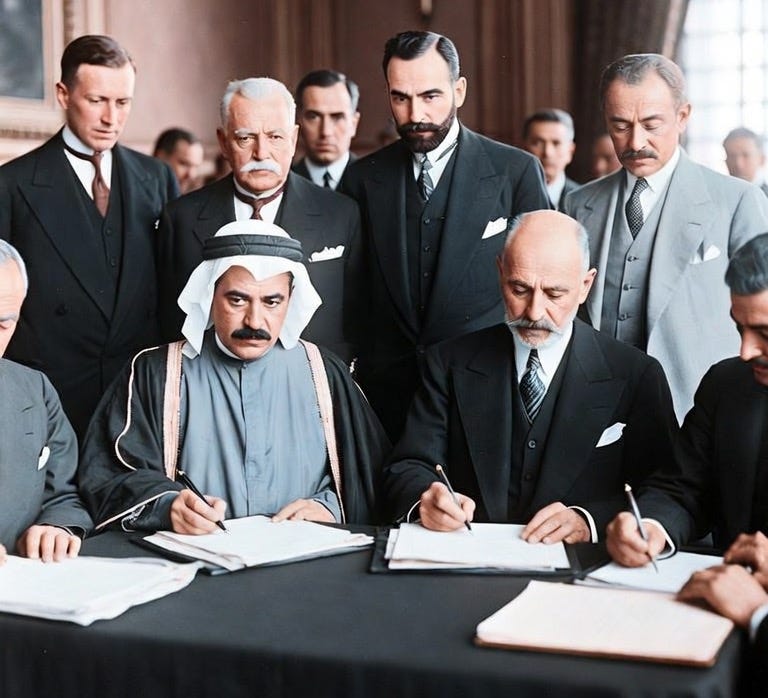
The rump west of the river went to the Peel Commission in 1937, which proposed dividing it again into Jewish and Arab states. The Jewish Agency accepted the principle, reluctantly, over the size of the proposed state and the fate of Jerusalem. The Arab Higher Committee rejected it outright, and the revolt already under way continued. A decade later, Britain’s own Foreign Secretary, Ernest Bevin, a man with no reputation for Zionist sympathy, gave the House of Commons the plainest diagnosis anyone in this story ever offered: “His Majesty’s Government have thus been faced with an irreconcilable conflict of principles… For the Jews the essential point of principle is the creation of a sovereign Jewish State. For the Arabs, the essential point of principle is to resist to the last the establishment of Jewish sovereignty in any part of Palestine.” That was not a partisan verdict. It was a tired imperial administrator’s honest account of why the Mandate had become ungovernable, and it has aged better than almost anything else said in that debate.
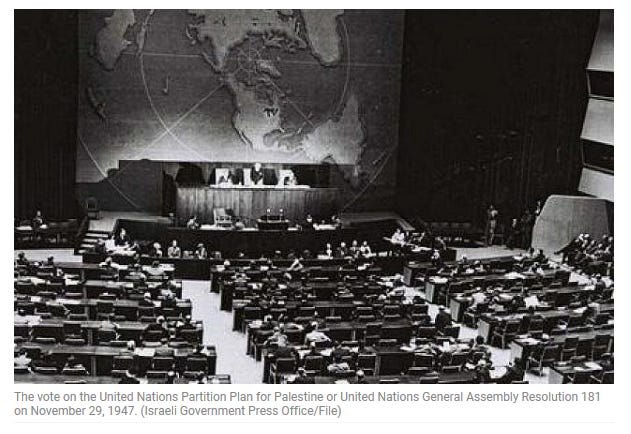
The United Nations inherited the problem and, in November 1947, proposed the same division a third time. The Jewish Agency accepted; the Arab League and the Arab Higher Committee did not, and five Arab armies crossed into the new state within a day of its declaration. Israel’s own founding document had gone out of its way to invite the alternative, appealing to “the Arab inhabitants of the State of Israel to preserve peace” and to neighbouring states “to establish bonds of cooperation and mutual help.” The Arab League’s own secretary-general, Azzam Pasha, told the Egyptian press on the eve of the invasion that it would be a war of extermination. The armistice lines drawn in 1949, called the Green Line, were left deliberately unrecognised as permanent borders, at Arab insistence, precisely so that the claim to the rest could be renewed by force at a more convenient moment. Egypt tried exactly that in 1956, closing the Straits of Tiran to Israeli shipping and giving Israel, France and Britain their pretext for the Suez campaign.
It is worth being precise about what the Palestine Liberation Organisation was actually founded to do in 1964, because the founding document survives and says it plainly. Article 2 of the Palestine National Charter defined “Palestine, with its boundaries at the time of the British Mandate,” as an indivisible unit, the whole territory, including the state that already existed inside the Green Line. Article 24, by contrast, disclaimed any PLO sovereignty “over the West Bank in the Hashemite Kingdom of Jordan, on the Gaza Strip or the Himmah Area”, the territories, that is, that a Palestinian state might actually have been built in, then under Jordanian and Egyptian control respectively. The target, at the movement’s founding, was not statehood in the West Bank and Gaza. It was Israel, inside its 1949 lines. That should unsettle anyone who assumes the conflict has always been a border dispute rather than, at its root, a dispute over whether the neighbouring state gets to exist at all.
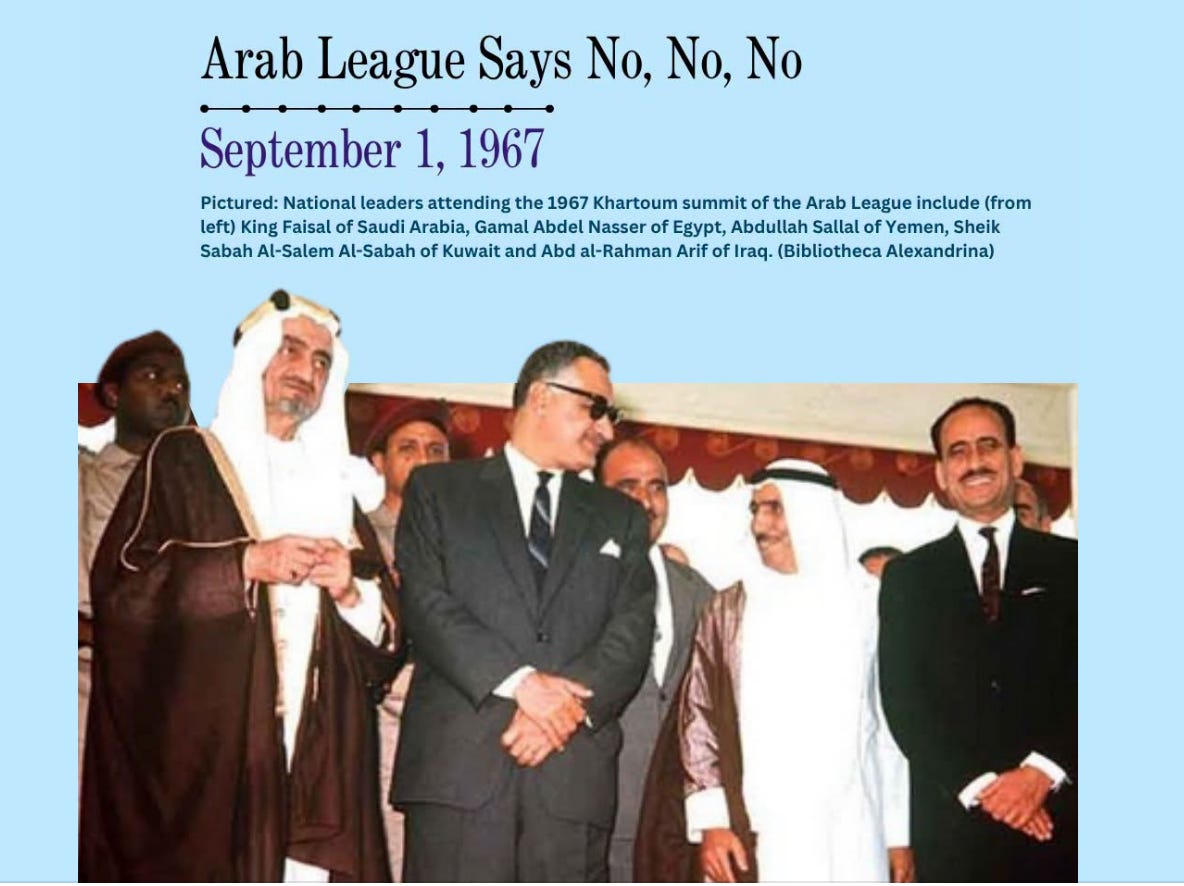
The wars of 1967 and 1973 followed, and in between them came the Arab League’s Khartoum Resolution of September 1967, whose famous third clause needs no interpretation: “no peace with Israel, no recognition of Israel, no negotiations with it.” The following year’s revision of the Palestinian National Charter quietly dropped Article 24’s renunciation and asserted PLO sovereignty over the whole of Mandate Palestine outright. Those commitments hardened, by 1977, into what Palestinian political culture calls the Thawabit, the national constants — right of return, all of Palestine including Jerusalem, resistance by any means — reaffirmed as recently as the 2005 Cairo Declaration and never formally retired by any Palestinian leadership since, whatever tactical accommodations individual leaders have made around them.
Set against that, Israel’s record with states willing to recognise it is a study in the opposite direction: full withdrawal from Sinai, taken by force in 1967 and handed back in its entirety for peace with Egypt in 1979; a treaty with Jordan in 1994 that settled the border without another shot fired. Where the other side said yes, Israel gave up land, including land far larger than the West Bank. The Oslo process, beginning in 1993, was the attempt to extend that logic to the Palestinians directly, interim Palestinian self-government building, in principle, toward final-status statehood. It ran alongside a rising toll of suicide bombings through the 1990s and collapsed for good after Ehud Barak’s offer at Camp David in July 2000, made with the backing of an Israeli electorate that had put him in office to pursue exactly that deal. Yasser Arafat neither accepted it nor offered a counterproposal. The answer, that September, was the Second Intifada. Ehud Olmert’s offer in 2008, more generous still, met the same silence from Mahmoud Abbas.
In 2005 Israel went further than any negotiation required and withdrew unilaterally from Gaza, dismantling every settlement and removing every soldier, handing over a functioning territory with no Palestinian concession demanded in return; as close to a real-world trial run of Palestinian self-government as the conflict has produced. Hamas won the following year’s legislative election and, in 2007, took Gaza from the Palestinian Authority by force. What followed was not state-building but two decades of tunnels, rocket stockpiles and cross-border raids, culminating on 7 October 2023 in the deadliest single day for Jews since the Holocaust. A statelet was offered. What came back, on the only occasion the experiment was actually run, was war.
None of this is an argument that Israeli governments have always acted wisely, or that settlement expansion in the West Bank is cost-free to the very outcome London says it wants to protect, a self-inflicted wound is still a wound. But the question in the title has an answer, and it is not the one Whitehall’s language implies. A solution that has been offered by one side in 1937, 1947, 1967, 2000 and 2008, and unilaterally enacted by that same side in 2005, has not quietly died of drift or neglect. It has been killed, on each occasion, by the leaderships that said no, and by a movement whose own founding charter named the target as the state inside the 1949 lines rather than the territories a Palestinian state would actually occupy.
There is a further irony Westminster has not sat with. The Mandate already produced a second state on its territory, in the very first years of British administration; one carved expressly to accommodate Arab self-government alongside the Jewish national home, comprising the great majority of the Mandate’s land, and today a kingdom whose population is majority Palestinian by origin. Jordan is not a metaphor for a solution; under the Mandate’s own logic, it is one. If the ambition is genuinely to see the Arabs of Mandate Palestine governed by their own people on their own land, that bill was substantially paid in 1922 and 1946, decades before anyone in London had heard the phrase “two-state solution.” What is being demanded of Israel now is not the completion of that bargain. It is a second concession, on top of the first, from the only party that has ever said yes.
Israel has absorbed this lesson at a cost measured in generations and, this century, in the bodies carried out of a music festival and a string of kibbutzim near Gaza. The rest of the world, judging by Tuesday’s statement, has not absorbed it at all. Perhaps the clearest evidence of that is the chant that goes up outside the building where Miliband spoke, the one that promises Palestine “from the river to the sea.” It is not, whatever its defenders claim, a demand for a second state alongside the first. Read against the documents above, it is the same demand the Arab Higher Committee made in 1937, the Arab League made in 1947, and the Palestine Liberation Organisation’s founders wrote down in 1964 — that there be no river-to-sea territory left for a Jewish state at all. The people singing it are not mourning a two-state solution. They are still, openly, working to finish the job of killing it.
YouTube: @Ultracrepidarian-w8b7w
X: https://x.com/fatdafevy
If you enjoyed this content please consider helping his future content
https://buymeacoffee.com/theultracrepidarian
Netanyahu.
https://www.972mag.com/netanyahu-hamas-october-7-adam-raz/